
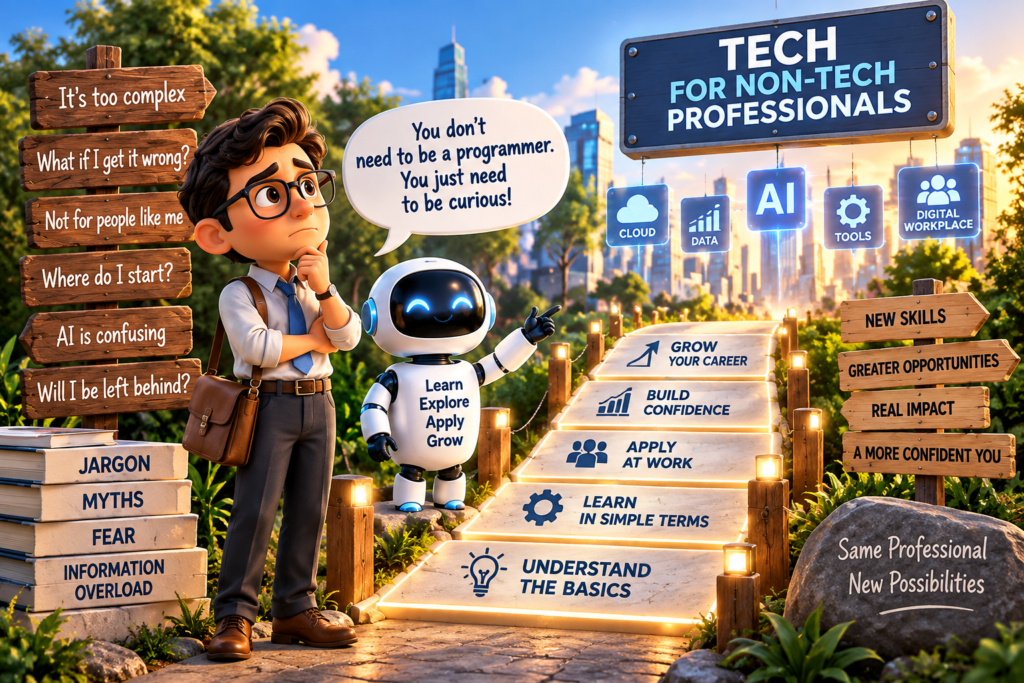
Technology is changing every profession. Understanding it shouldn't require you to become a programmer.

“AI is changing everything.”
“You need to understand the cloud.”
“Automation will transform jobs.”
“Every business needs digital transformation.”
“Learn cybersecurity. Learn data. Learn AI.”
If you come from a non-technical background, statements like these can create more anxiety than excitement.
You may be successful in sales, finance, human resources, operations, marketing, administration, education or another profession. You may have spent years developing expertise in your field.
And suddenly, technology seems to have entered every conversation.
Artificial Intelligence. Cloud Computing. Cybersecurity. APIs. Automation. Data Analytics. Machine Learning. ERP. Digital Transformation.
The terminology keeps growing.
So does the uncomfortable question:
“Am I falling behind?”
If you have ever felt that way, this article is for you.
The good news is simple: you do not need to become a software developer to become confident with technology.
The Real Problem Isn't Technology. It's the Way We Learn It.
For many non-technical professionals, the first barrier to technology isn't capability.
It is language.
Imagine walking into a meeting and hearing:
“We'll integrate the application through APIs, move the workload to the cloud, automate the workflow and use AI-driven analytics.”

Everyone around the table appears to understand. You don't, So you remain silent.
Later, you search the terms online—and discover hundreds of articles, videos, courses and certifications.
Now another problem begins.
Where do you start?
One video tells you to learn Python.
Another recommends Artificial Intelligence.
Someone else says Cloud Computing.
A course advertisement tells you Data Science is the future.
Another tells you Cybersecurity has enormous opportunities.
Instead of clarity, you get more confusion.
This is one of the biggest challenges facing people trying to move from non-tech to tech today: there is no shortage of information, but there is a serious shortage of context and direction.
Pain Point #1: “Technology Feels Too Complicated for Me”
Technical terminology can make relatively simple ideas sound intimidating.
Take cloud computing.
At its simplest, instead of every organisation buying and maintaining all its computing infrastructure itself, it can access computing resources and services remotely when required.
The actual technology behind cloud platforms can be highly sophisticated.
But understanding the business purpose of cloud computing does not require you to understand every technical component.
The same applies to Artificial Intelligence.
You don't need to understand how to build a large language model before learning how AI can improve productivity, analyse information, automate repetitive work or support decision-making.
The first step towards becoming tech-confident is therefore not learning everything.
It is learning the right things at the right depth.
Pain Point #2: “There Is Too Much to Learn”
This is where many people stop before they even begin.
Should you learn:
AI?
Cloud?
Cybersecurity?
Data Analytics?
Programming?
Automation?
ERP?
Networking?
The answer is not “all of them.”
The better question is:
What technology knowledge will help you solve problems in your current role—or move towards the role you want next?
A finance professional may need to understand ERP systems, analytics, automation and AI-assisted forecasting.
A human resources professional may benefit from HR technology, workflow automation, analytics and responsible AI.
An operations leader may need knowledge of cloud services, automation, dashboards, cybersecurity, IT service management and AI-enabled operations.
Technology learning becomes far easier when it is connected to a real business problem.
Pain Point #3: “I Have Experience. Do I Really Need to Start Again?”
This is particularly worrying for experienced professionals.
After spending 10, 15 or 20 years building a career, the idea of moving towards technology can feel like returning to the beginning.
But your existing experience has not suddenly become irrelevant.
In many cases, it becomes your advantage.
Consider someone who has spent years managing business operations.
They already understand processes, customers, teams, risks, costs, deadlines and performance.
Now add knowledge of automation, cloud platforms, analytics and AI.
That person is not starting again.
They are adding technology to existing business expertise.
The future of work will not belong only to people who understand technology.
It will increasingly require people who can connect technology with real business outcomes.
Pain Point #4: “I Completed a Course, But I Still Can't Apply It”
This is where another kind of frustration begins.
You complete a course. You watch the videos, understand the terminology, finish the assessments and perhaps even earn a certificate.

But then someone asks a simple question:
“How would you actually use this in a business?”
And suddenly, the confidence disappears.
Because knowing about technology and knowing how to apply technology are two very different things.
Knowing the definition of automation is different from identifying a process that should be automated.
Knowing what cloud computing means is different from understanding why an organisation might migrate a workload to the cloud.
Knowing the basics of AI is different from identifying where AI can genuinely improve a workflow.
Real technology confidence develops when learning moves through three stages:
Understand → Apply → Solve
This is why practical learning, case studies, projects and real-world business scenarios matter.
A certificate may demonstrate that you completed a course.
Capability demonstrates that you can use what you learned.
Pain Point #5: “Our Company Is Investing in Technology, But Nothing Seems to Change”
Technology confusion doesn't exist only at an individual level.
Businesses experience it too.
Organisations invest in new tools, cloud platforms, ERP systems, websites, dashboards, automation and AI initiatives—but still struggle with inefficient processes.
Why?
Because buying technology is not the same as transforming a business.
Digital transformation requires more than software.
It requires organisations to understand their existing operations, identify genuine pain points, redesign processes, select appropriate technology, implement it properly and ensure people actually adopt it.
The same applies when organisations build technology operations or Global Capability Centres (GCCs).
The challenge isn't simply creating infrastructure or hiring teams.
Successful technology operations require thoughtful design, build and run models—covering people, processes, governance, service management, automation, security, performance measurement and continuous improvement.
Technology creates value only when it solves the right problem.
From Technology Consumer to Technology-Confident Professional
Most of us already use technology throughout the day.
We use digital payments, navigation applications, streaming platforms, online shopping, collaboration tools and smartphones.
Yet many people still say:
“I'm not a technology person.”
Perhaps the better question is:

How much technology do you need to understand to make better decisions?
You don't need to know how an aircraft engine is built to travel by air.
But if your job involves aviation, deeper understanding becomes useful.
Technology works similarly.
Your goal should not necessarily be to become a programmer, cloud architect, cybersecurity engineer or data scientist.
Your first goal can simply be:
Become confident enough to understand technology, ask better questions and recognise where it can create value.
That is a far more achievable starting point.
Learn. Transform. Create.
This philosophy is central to what we are building at Yantrikmedha Solutions.
LEARN
Technology learning should begin with understanding—not jargon.
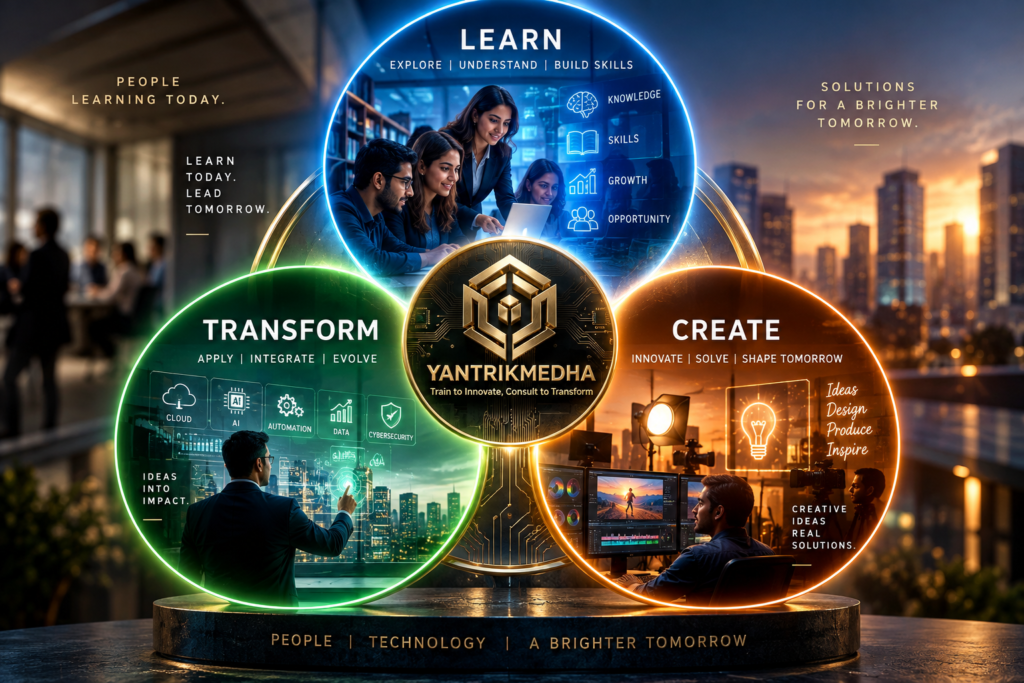
We want to help professionals and learners understand areas such as Artificial Intelligence, Cloud Computing, Cybersecurity, IT Infrastructure, automation and digital technologies through practical, business-relevant learning.
The objective isn't simply knowledge.
It is confidence and application.
TRANSFORM
For organisations, knowing about technology is only the beginning.
The next challenge is execution.
From operational transformation and AI strategy to cloud and IT infrastructure, intelligent automation, IT operations and GCC design, build and run, transformation requires technology to work in the real world.
The question changes from:
“What does this technology do?”
to:
“How can we use it to improve our business?”
CREATE
Technology also gives organisations the ability to create.
Websites.
ERP products.
Digital experiences.
Graphics.
Advertisements.
Corporate films.
Music videos.
AI-assisted creative content.
Technology and creativity are no longer separate worlds. Increasingly, they work together to shape how organisations build products, communicate ideas and engage customers.
That intersection is where Create begins.
Your Journey Doesn't Start With Coding
If you are considering moving towards technology, don't begin by asking:
“Which programming language should I learn?”
Start with three different questions:
What problems do I understand?
What technology can help solve those problems?
What should I learn next to connect the two?
That changes everything.
A career in the technology-driven world does not always require abandoning your previous experience.
Sometimes the most powerful transition happens when you combine what you already know with what technology now makes possible.
You don't need to understand everything today.
You need to understand one concept better than you did yesterday.
Then another.
And another.
That is how technology stops feeling intimidating.
That is how curiosity replaces hesitation.
And that is how you move from non-tech to tech-confident.
This Is Just the Beginning
Demystifying Tech is the beginning of a series from Yantrikmedha Solutions designed to make technology understandable, practical and relevant.
In our upcoming blogs, we will break down topics such as Artificial Intelligence for non-technical professionals, Cloud Computing without jargon, Cybersecurity basics, automation, ERP, digital transformation, GCC design-build-run, AI-enabled operations, website development and the changing relationship between technology and creativity.
No unnecessary complexity.
No technology jargon for the sake of sounding technical.
Just practical conversations about what technology is, why it matters and how you can use it.
If technology has ever made you feel that you are standing outside a door everyone else somehow knows how to open, stay with us. Lets decode the Basics, Corelate and Move ahead.
It is okay to take baby steps . Our journey is starting....but long way to go. Lets go together and learn to shine
Follow the Yantrikmedha Solutions website and our upcoming blogs as we continue to demystify technology—one topic at a time.
Yantrikmedha Solutions
Train to Innovate. Consult to Transform.
Learn. Transform. Create.